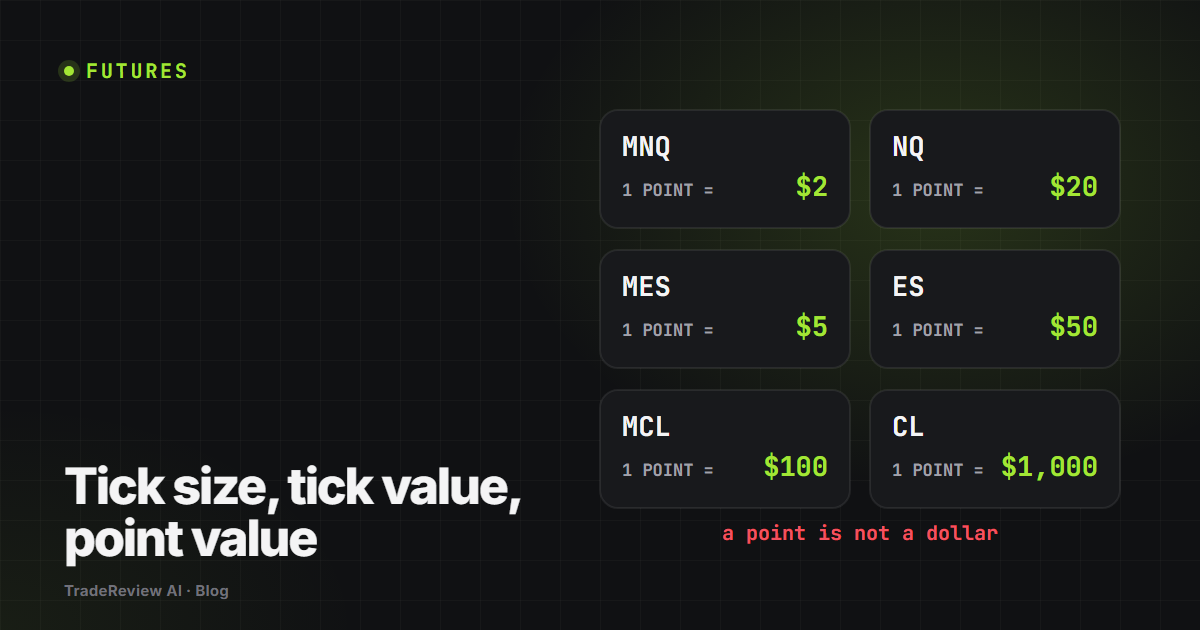
Three terms, often confused, and each one matters.
- Tick size - the smallest price increment the contract can move. For the E-mini S&P (ES) that is 0.25.
- Tick value - what one of those increments is worth, per contract. For ES that is $12.50.
- Point value - what a full point of price is worth. ES moves in quarter points, so a point is four ticks: 4 × $12.50 = $50.
The table that fixes most spreadsheet errors
| Contract | Tick size | Tick value | Point value |
|---|---|---|---|
| ES - E-mini S&P 500 | 0.25 | $12.50 | $50 |
| MES - Micro S&P 500 | 0.25 | $1.25 | $5 |
| NQ - E-mini Nasdaq | 0.25 | $5.00 | $20 |
| MNQ - Micro Nasdaq | 0.25 | $0.50 | $2 |
| CL - Crude Oil | 0.01 | $10.00 | $1,000 |
| MCL - Micro Crude | 0.01 | $1.00 | $100 |
| GC - Gold | 0.10 | $10.00 | $100 |
| MGC - Micro Gold | 0.10 | $1.00 | $10 |
| 6E - Euro FX | 0.00005 | $6.25 | $125,000 |
Check these against your broker's contract specifications before relying on them - exchanges do change contract terms, and some brokers quote micro contracts differently.
Why this breaks journals
Take a short MNQ trade entered at 20,150 and covered at 20,110. Forty points. A spreadsheet that subtracts one price from the other and stops there reports a $40 profit. The real figure is 40 × $2 = $80 per contract, and on three contracts it is $240.
Now run the same forty points on full-size NQ: 40 × $20 = $800 per contract. Same chart, same trade, twenty times the money. Any journal that does not know which contract you traded cannot tell you anything useful about either.
The risk side is worse
This is where it stops being a reporting problem and becomes an account problem. A trader who sizes a position by thinking in points rather than dollars, and who switches from a micro to a full-size contract, has multiplied their risk by ten without changing anything they were paying attention to.
Work risk in money, always: stop distance in points × point value × contracts. That is the number your daily loss limit is measured in.
Contract months are not different instruments
MNQZ5 and MNQH6 are the same contract three months apart. A journal that treats the code as the instrument name splits your Nasdaq history into four unrelated piles a year and makes a setup comparison impossible. The root - MNQ - is what you want to group on, with the month kept for the record.
Journal prompts
- Does my journal apply the correct point value, or am I logging points as dollars?
- What is my risk per contract in money on my usual stop distance?
- If I moved from micro to full-size contracts, did my per-trade risk change by ten times?