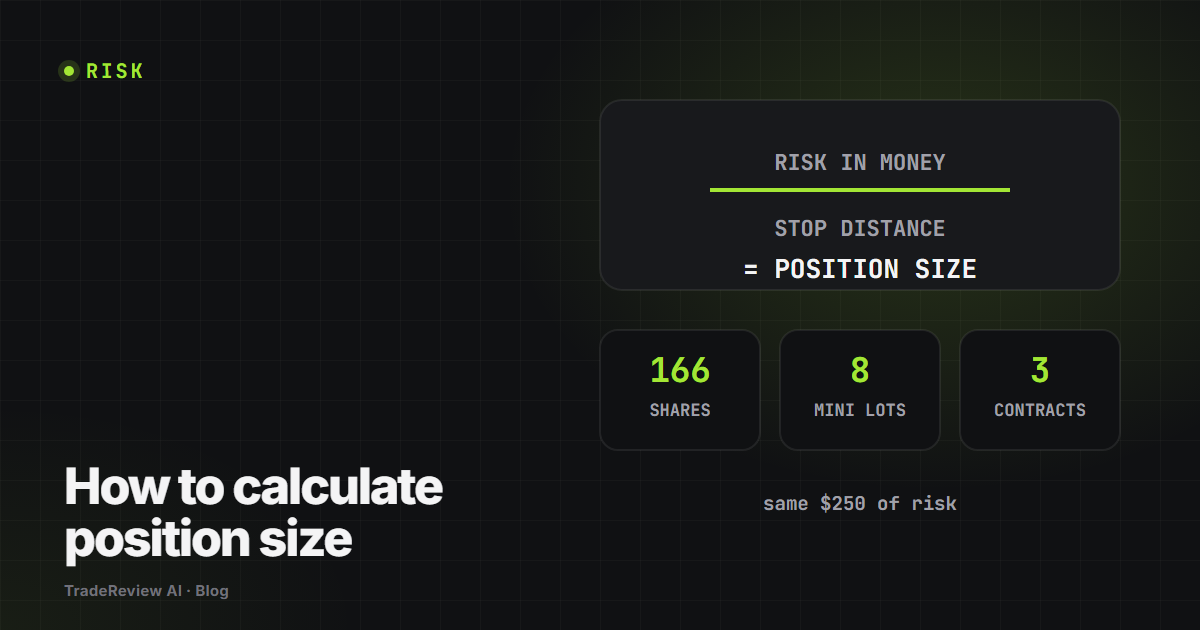
There is one formula, and everything else is a detail of the instrument you are trading.
The formula
Position size = money you are willing to lose ÷ distance to your stop
That is it. The account size only appears in the first half, through whatever percentage of it you have decided to risk. The entry price does not appear at all.
This is the part most people get backwards. They think "I have $10,000, I will buy $2,000 of this stock." But $2,000 of a stock with a wide stop risks far more than $2,000 of a stock with a tight one. The money at risk is the stop distance multiplied by the size - not the size on its own.
Stocks
You have a $25,000 account and risk 1% per trade, so $250. You want to buy at $48.00 with a stop at $46.50.
- Stop distance: 48.00 − 46.50 = $1.50 per share
- Shares: 250 ÷ 1.50 = 166 shares
- Position value: 166 × 48.00 = $7,968 - which is 32% of the account, and that is fine, because the risk is still $250
Forex
Same $250 of risk. You are long EUR/USD at 1.0850 with a stop at 1.0820 - a 30 pip stop.
- On a standard lot (100,000 units) a pip is about $10, so 30 pips is $300 - too much.
- On a mini lot (10,000 units) a pip is about $1, so 30 pips is $30.
- Lots: 250 ÷ 30 = 8.3 mini lots, so round down to 8.
Rounding down rather than up is not timidity. It is the only direction that cannot break the rule you just set.
Futures
Futures are where the arithmetic bites, because a point is not a dollar. One point of Micro Nasdaq (MNQ) is $2. One point of the full E-mini Nasdaq (NQ) is $20. One point of Micro Crude (MCL) is $100.
Same $250 of risk, long MNQ at 20,150 with a stop at 20,110 - a 40 point stop.
- Risk per contract: 40 points × $2 = $80
- Contracts: 250 ÷ 80 = 3.1, so 3 contracts
Run that same stop on full-size NQ instead and risk per contract is $800 - more than three times your whole risk budget, on one contract. This is the single most common way a futures account is destroyed in a week by someone who was being careful.
Crypto
Crypto quantities are fractional, which makes the maths easier, not harder. $250 of risk, long BTC at $64,000 with a stop at $62,400 - a $1,600 move.
- Size: 250 ÷ 1,600 = 0.156 BTC
What percentage should you risk?
One percent per trade is the common answer and a reasonable default. The reason is not that 1% is magic - it is that it survives a losing streak. Ten losses in a row at 1% leaves you down about 10%. At 5% it leaves you down 40%, and a 40% drawdown needs a 67% gain to recover.
If you are on a prop firm evaluation, the percentage is decided for you by the daily and maximum loss limits, and it is usually smaller than you would choose.
The part nobody does
Calculating size before the trade is half the job. The other half is checking afterwards whether you actually did it - because the trades where people abandon their own sizing are not random. They cluster after a loss, and they are the trades that do the damage.
That is what a journal is for. Record the risk you planned, and the risk the trade actually used, and compare them. If those two numbers disagree regularly, the problem is not your strategy.
Journal prompts
- On how many trades last month did the risk I used exceed the risk I planned?
- Were those trades taken right after a loss?
- What is my largest single-trade loss as a percentage of the account?