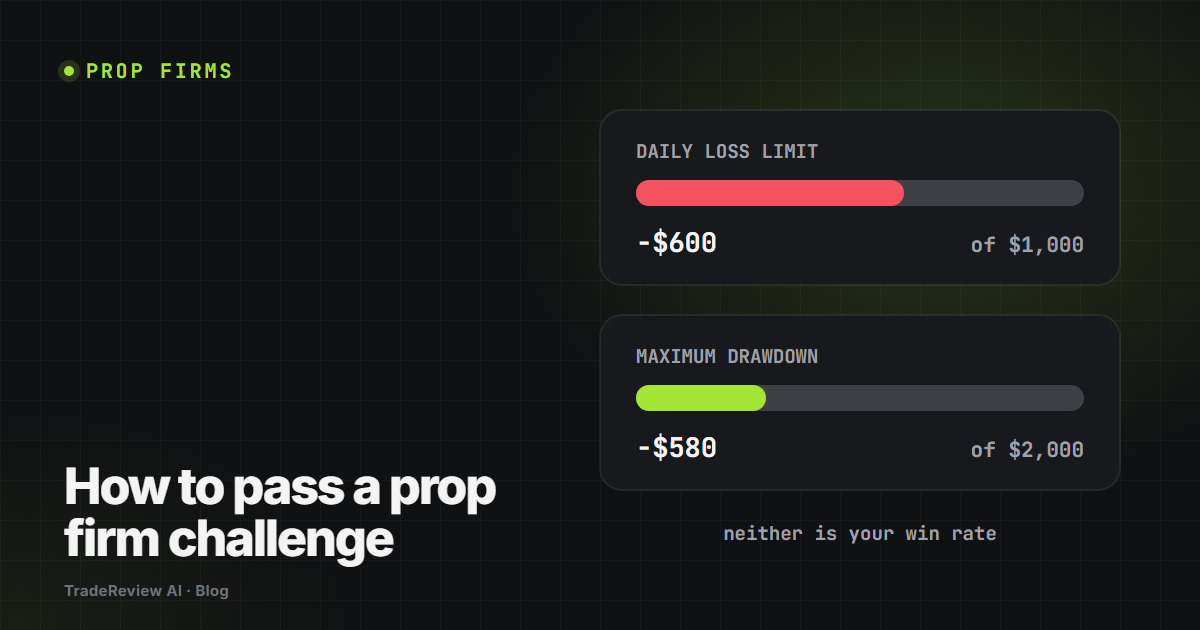
A prop firm evaluation is not a trading competition. It is a risk management test with a profit target attached, and the profit target is the easy half.
The rules that actually end accounts
- Daily loss limit. The one that catches most people. It resets each session, which makes it feel generous, and it can be reached in one bad twenty minutes.
- Maximum loss / trailing threshold. Measured from your highest balance, so it tightens as you make money - counterintuitive and the reason people fail after a good week.
- Consistency rule. No single day may be more than a set share of total profit. One huge day can fail you even while the account is up.
- Minimum trading days. Stops you passing on one lucky trade.
Size for the daily limit, not for the target
Work backwards. If the daily loss limit is $1,000, decide how many losing trades in a row you must be able to take without hitting it. Four is a reasonable floor; six is safer. That makes your per-trade risk $250 or $166, not whatever number the profit target tempts you towards.
This is the whole discipline in one decision, and it is made before you place a single trade. Most failed evaluations can be traced to a per-trade risk that left no room for a normal losing streak.
The failure has a shape
Blown evaluations are rarely one bad trade. The sequence is almost always the same:
- A normal stop-out, inside the plan.
- A second trade within a few minutes, larger, to get it back.
- A third, larger again.
- The daily limit, reached in under half an hour.
Every step after the first is a decision made to undo the step before it. If you journal nothing else during an evaluation, record the time of every entry. The gap between a loss and the next entry is the single most predictive number you have, and it is easy to measure.
What to do on the day you are down
Set a personal daily stop well inside the firm's. If the limit is $1,000, stop at $500. The firm's number ends the account; yours ends the day, and a day you can walk away from costs nothing.
Write the rule before the session, not during it. During it, you will have reasons.
The trades that win and still break the rule
A trade that used three times your planned risk and came out green is not a success. It is the same decision as the one that ends the account, with a luckier outcome, and it is the one you are most likely to repeat - because it worked.
Mark those separately from your losing trades. They are a different list, and the first predicts the second.
After you pass
The funded account has the same limits and a real payout attached, which changes the psychology, not the maths. Traders who pass and then blow the funded account almost always do it by increasing size - the strategy that passed the evaluation was sized for the evaluation.
Journal prompts
- How many consecutive losses can I take before hitting the daily limit at my current size?
- What is my median gap between a losing trade and the next entry?
- Which trades used more risk than I planned, including the winners?