With a stock, the outcome has one driver: the price went your way or it did not. With an option, three things move the result at once, and two of them can beat you while you are right about the first.
The fields to add
- Strike and expiry - obvious, and still missing from most spreadsheets, which store the whole OCC code as a name.
- Days to expiration at entry - the single most useful extra field. Grouping results by DTE buckets reveals more than almost any other breakdown.
- Implied volatility at entry - whether you bought expensive or cheap, which you cannot reconstruct afterwards.
- Premium paid or received - on a long option this is your maximum loss, which makes risk a fact rather than an estimate.
- Underlying price at entry and exit - so you can separate "I was wrong about direction" from "I was right and still lost".
Premium is the real risk number
On a long call or put the most you can lose is what you paid: contracts × premium × 100. That is a number a journal can work out rather than ask you for.
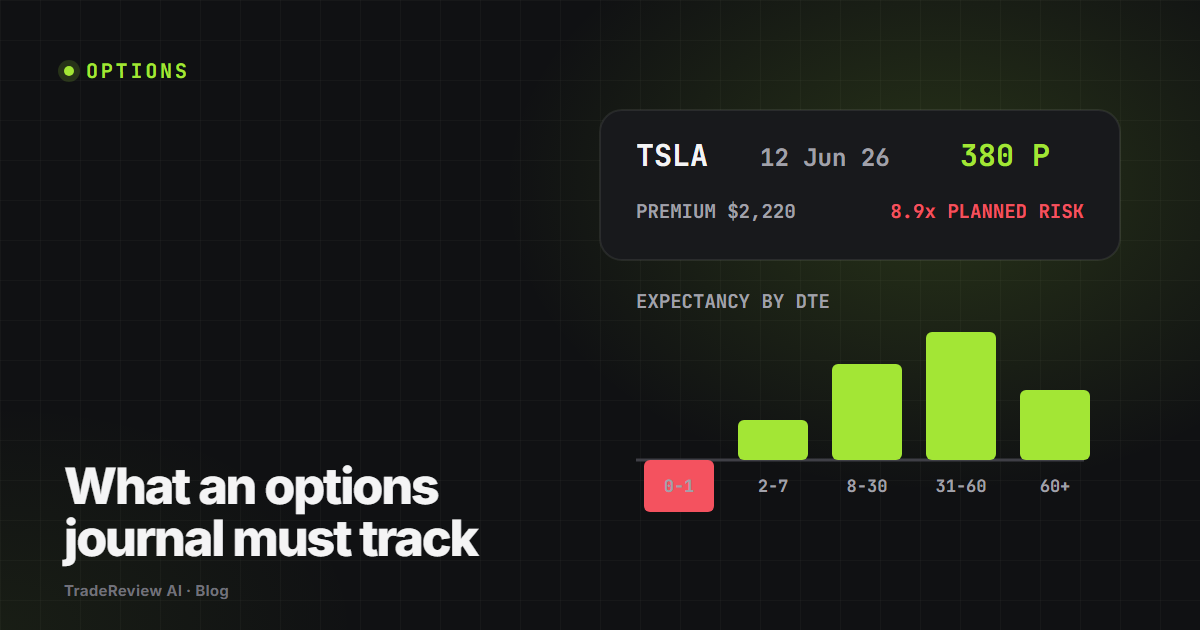
Three contracts at 7.40 is $2,220. If your plan said risk $250 per trade, that position is 8.9 times your intended risk - and it is worth seeing that stated plainly whether the trade won or lost. Options make oversizing easy precisely because the dollar amounts look small on the ticket.
Days to expiration changes the game, not the odds
The same directional idea expressed at 45 DTE and at 2 DTE is two different trades. The short-dated version needs the move to happen almost immediately; the longer one survives being early. Most traders have a clear best and worst DTE bucket and have never looked.
Group your results into buckets - 0-1, 2-7, 8-30, 31-60, 60+ - and compare expectancy. The answer is usually unambiguous and often uncomfortable.
Right about direction, wrong about the trade
Record the underlying price at entry and exit alongside the option's. Then you can sort your losing trades into two piles:
- The underlying went against you. A normal loss. The thesis was wrong.
- The underlying went your way and you still lost. Theta, a volatility crush after an earnings release, or a strike too far out of the money.
Those two piles need completely different fixes, and a journal that only records P/L cannot tell them apart.
Multi-leg positions
Record the legs, not a net figure. A spread that nets to a small loss can hide a short leg assigned early or a long leg closed at the wrong moment. Keep the legs as separate rows grouped under one setup tag, so the fills stay accurate and the decision is still reviewed as one.
Journal prompts
- What is my expectancy by DTE bucket?
- On my losing trades, how often did the underlying actually move my way?
- What is my average premium paid as a multiple of my planned risk?