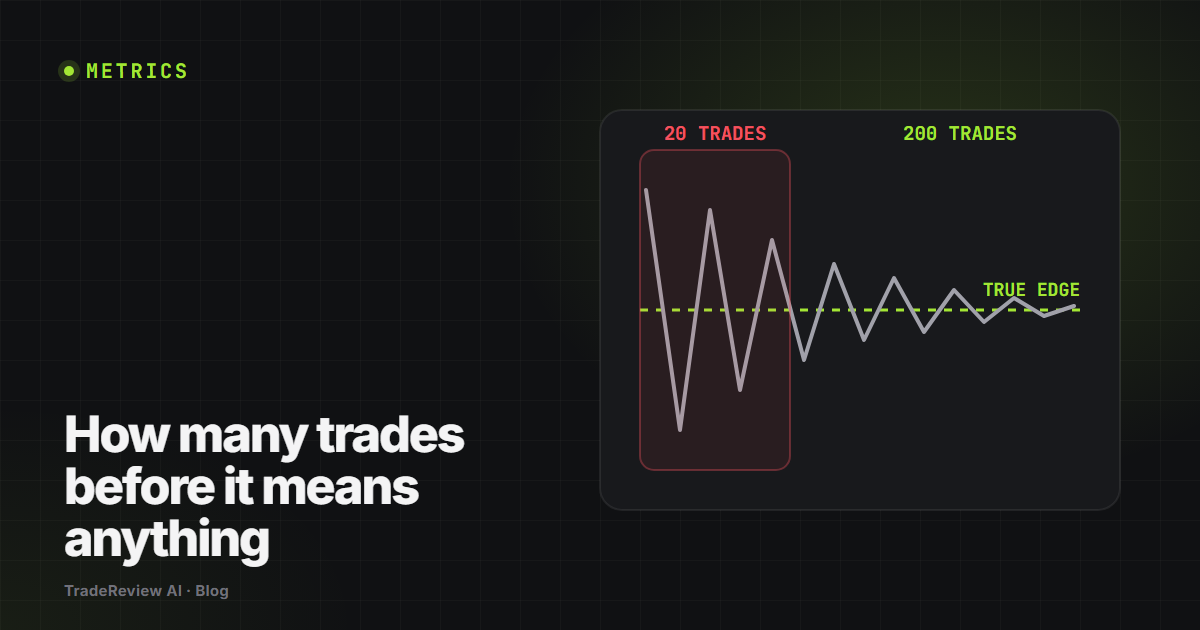
This is the most common way traders fool themselves, and it is not a psychology problem. It is arithmetic.
What a small sample can do
Take a strategy that genuinely wins 50% of the time. Over 20 trades, getting 13 or more wins happens roughly a fifth of the time by chance alone - a 65% win rate from a coin flip. Getting 7 or fewer is equally likely, and that trader concludes the strategy is broken and abandons it.
Same strategy. Two opposite conclusions. The only difference is which twenty trades happened.
Rough guidance
- Under 30 trades - tells you almost nothing about edge. Useful only for checking you can follow your own process.
- 30 to 100 - a signal starts to appear, but a single outsized trade still moves everything.
- 100 to 300 - win rate and average win/loss become reasonably stable for most intraday strategies.
- 300+ - you can start comparing setups against each other with some confidence.
These are not thresholds where the numbers become true. Confidence increases gradually, roughly with the square root of the sample: to halve your uncertainty you need four times the trades.
The trap of slicing
This is where sample size quietly destroys most journal analysis. You have 200 trades, which feels plenty. Then you break them down by setup (5 setups), by hour (6 hours), and by day of week. You now have cells containing seven trades each, and you are drawing conclusions from every one of them.
Every extra dimension divides your sample. Look at one breakdown at a time, and check the trade count before you believe any of them.
What to do with a small sample
You do not have to wait for 300 trades to learn something. You just have to ask different questions - ones about process rather than about edge:
- Did I follow my plan? Answerable from ten trades. Count how many matched a written setup.
- Did I size as planned? Compare risk planned against risk used. One trade tells you something.
- Did I take my stops? Count the losses larger than your planned risk.
- How long after a loss did I re-enter? Visible almost immediately.
These are the questions worth asking in your first month. They are all about behaviour, they all have answers at small sample sizes, and behaviour is the thing you can change this week.
One more thing that ruins samples
Check whether one trade is carrying the result. Remove your single best trade and recalculate expectancy. If the edge disappears, you do not have a strategy with a good average - you have a lucky trade and a lot of noise around it.
Journal prompts
- How many trades are actually behind each setup's statistics?
- What happens to my expectancy if I remove my single best trade?
- Which of my conclusions rest on fewer than 30 trades?