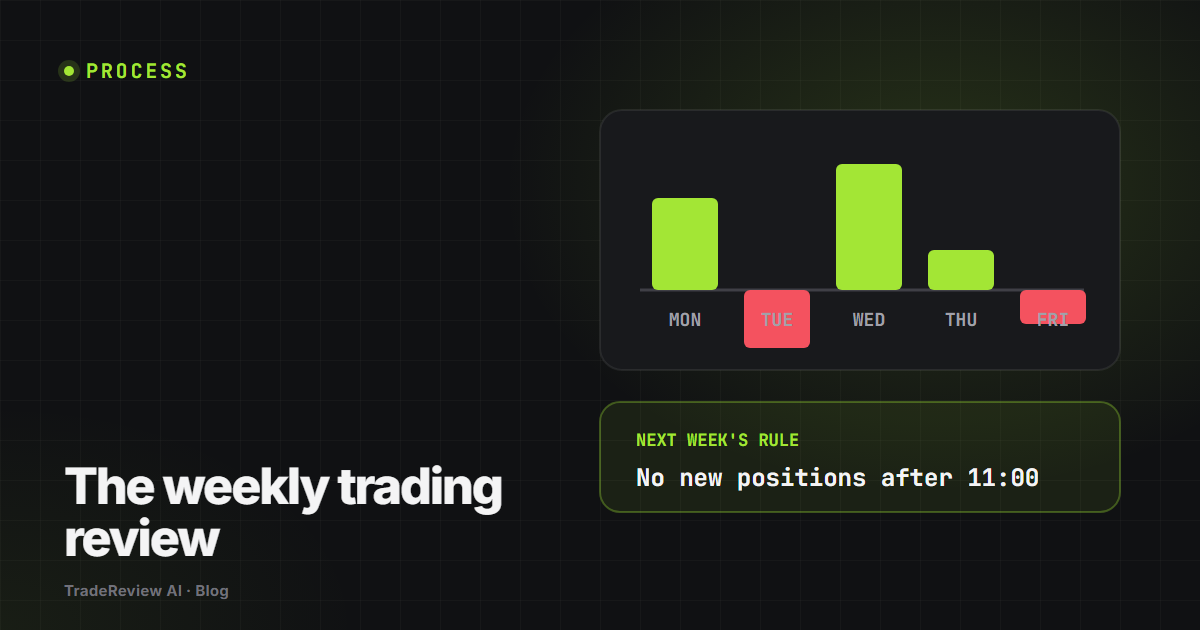
Thirty minutes, once a week, same time. Sunday evening or Monday before the open - it matters less which than that it is fixed, because a review you do when you feel like it is a review you do after good weeks.
The five questions
1. Did I follow my plan?
Not "did I make money". Count the trades that matched a written setup, and the trades that did not. That ratio is the single most important number in the review, and it has nothing to do with the week's P/L.
2. Which setup made and lost the most?
By expectancy, not by total. A setup that made $800 across forty trades and one that made $600 across four are not comparable, and the second one is more interesting.
Check the trade count before you conclude anything.
3. What was my worst trade, and why?
One trade. Open the chart, look at the entry and exit screenshots, and write one sentence about what you were thinking. Not the loss itself - losses are part of it - but whether the decision was one you would make again.
4. What was my worst decision?
Often a different trade entirely, and usually a winner. The trade where you tripled size and got away with it is the decision that will end a month later on. If you only review losses you will never see it.
5. When did I trade well?
Look at results by hour and by day. Most traders have a pattern they have never noticed - a strong first hour, a late-morning drift, a Friday that gives back the week. Four weeks of this and the pattern is either real or it is not.
What to ignore
- The week's total P/L. Five days is noise. It tells you about the market, not about you.
- Trades you did not take. The ones that would have worked are infinite and free to imagine.
- Market predictions. The review is about your behaviour, which is the only part you control.
The output is one rule
End the review by writing a single rule for next week, in one sentence, specific enough to break obviously:
- "No new positions after 11:00."
- "No second trade within five minutes of a loss."
- "Maximum three trades per day."
- "No size above two contracts until I have twenty trades at two."
One rule, because you will not keep five. Next week, the first question of the review is whether you kept it.
Why this compounds
Done for a quarter, that is thirteen rules tested against your own data, each one aimed at whatever the previous week exposed. That is a measurable process, and it is roughly the opposite of reading more about strategy.
Journal prompts
- What share of this week's trades matched a written setup?
- What was my worst decision, including the winners?
- Did I keep last week's rule?