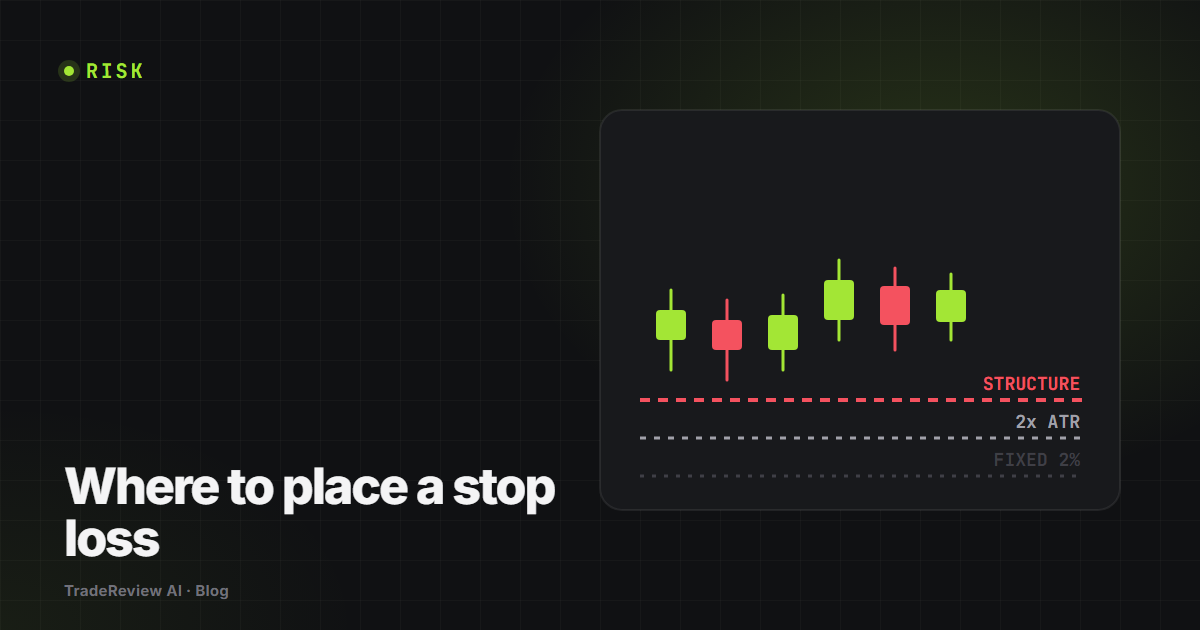
The most common stop loss mistake is not placing them too tight or too wide. It is deciding the dollar amount first and then finding a price that matches it - which puts your stop wherever your account size happens to put it, rather than where the trade is wrong.
Structure stops
Place the stop beyond the level that would invalidate the idea: under the swing low you are buying the bounce from, above the range high you are shorting.
Fits: breakout and reversal setups, anything built on a clear level.
Costs: stop distance varies trade to trade, so position size has to be recalculated every time. That is a feature, not a nuisance - it is what keeps risk constant.
Fails when: the obvious level is obvious to everyone, and price runs through it before reversing. Giving it a small buffer beyond the exact level helps more than it costs.
ATR stops
Use a multiple of Average True Range - commonly 1.5 to 2 times the 14-period ATR. The stop widens in volatile conditions and tightens in quiet ones, automatically.
Fits: trend following, and any strategy traded across instruments with different volatility.
Costs: the stop sits at a price with no meaning to anyone else, which can feel arbitrary.
Fails when: volatility jumps suddenly - ATR is backward-looking and lags a regime change by design.
Percentage stops
A fixed percentage from entry: 2% on a stock, 1% on an index.
Fits: longer-term positions and portfolios, where simplicity is worth more than precision.
Costs: it ignores the chart completely. A 2% stop can sit in the middle of a normal daily range on one instrument and miles away on another.
Fails when: used intraday, where normal noise is frequently larger than the percentage you chose.
How to pick
Pick per setup, not per trade, and keep it. The method should be in your written plan next to the setup it belongs to, so that it is decided before you are in the position.
Then measure it. Tag each trade with the method used and compare them the way you would compare setups: average result, win rate, and - the one that matters here - how often you were stopped out and the trade then went your way. A high rate of those means the stop is too tight for the setup, not that stops are bad.
Moving a stop
Moving a stop further away is not a strategy adjustment. It is the decision to take a larger loss than you agreed to, made by someone currently losing money. Every journal that tracks it finds the same thing: these trades have a dramatically worse average outcome than trades where the stop was honoured.
Moving a stop in your favour - to break-even, or trailing - is a different act entirely, and worth testing. Measure whether it helps. For many setups, moving to break-even too early converts winners into scratches and quietly destroys the risk-reward ratio the whole plan depends on.
Journal prompts
- How often am I stopped out and then the trade goes my way?
- What is my average result on trades where I moved the stop away?
- Does moving to break-even help or hurt my expectancy?