Win rate is the most quoted and least useful number in trading, because on its own it cannot tell you whether you are making money. A trader who wins 70% of the time and loses three times more on the losers than they make on the winners is losing money. A trader who wins 35% of the time with winners three times the size of losers is doing well.
The break-even table
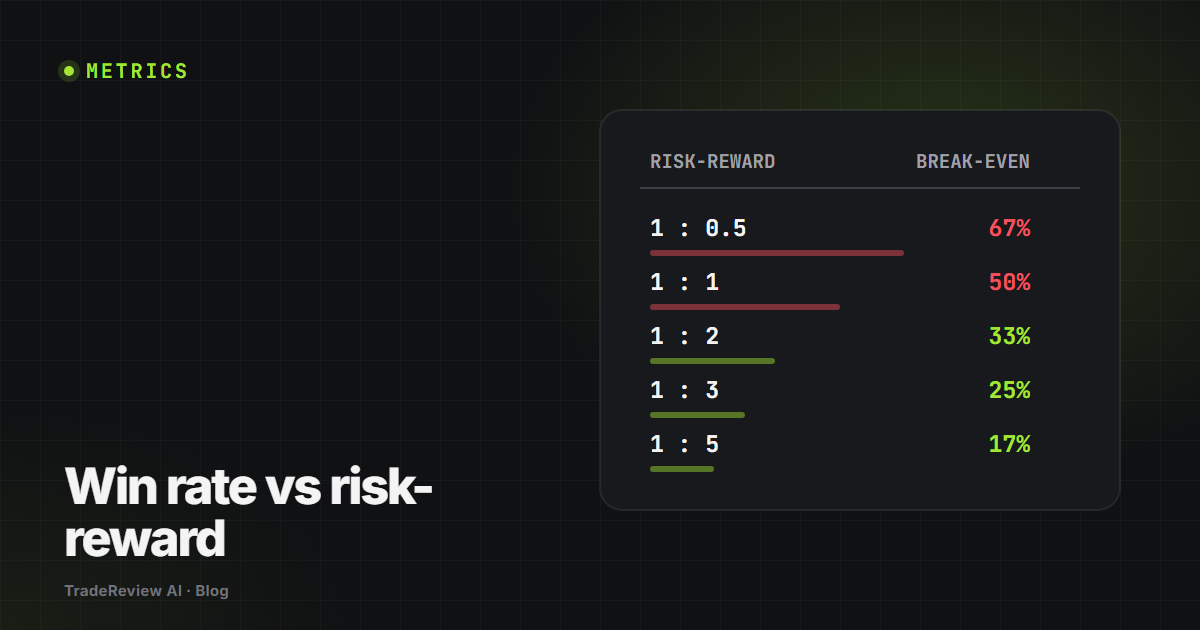
For any risk-reward ratio there is a win rate below which you lose money. This is the whole relationship in one table:
| Risk-reward | Break-even win rate |
|---|---|
| 1 : 0.5 | 66.7% |
| 1 : 1 | 50.0% |
| 1 : 1.5 | 40.0% |
| 1 : 2 | 33.3% |
| 1 : 3 | 25.0% |
| 1 : 4 | 20.0% |
| 1 : 5 | 16.7% |
The formula is break-even win rate = 1 ÷ (1 + reward/risk). Everything above the line is profit, before costs.
Reading your own numbers
Take your actual average win and average loss from the last hundred trades, not the ones your plan says you should have. Divide the average win by the average loss - that is your real risk-reward. Look it up in the table. Now compare it to your real win rate.
Three things usually turn up:
- The ratio is worse than planned. You plan 1:2 and achieve 1:1.2, because you take profits early on winners and let losers run past the stop. This is the most common finding in any journal.
- The win rate is fine but the margin is thin. You are 4 points above break-even, which disappears the moment fees and slippage are included.
- One setup is carrying everything. The overall numbers are average because a good setup and a bad one are cancelling out.
Why high win rate feels better and pays worse
Being right is pleasant, and a strategy that is right often is easier to keep trading. That is a real psychological advantage and it is not nothing. But high win rate strategies tend to have small winners and occasional large losers, which means the whole edge rests on the losers staying rare and staying small. One breach of that - one stop you did not take - and months of small wins are gone.
Low win rate strategies have the opposite problem. The maths is forgiving but the experience is not: six losses in a row is normal at a 35% win rate, and most people abandon the strategy during that stretch.
What to do about it
Do not try to raise win rate directly - that usually means taking profits sooner, which lowers the ratio and leaves you no better off. Work on the ratio instead, and the easiest place to find it is your losing trades. If your average loss is larger than your planned risk, you are not taking your stops, and fixing that single habit improves both numbers at once.
Journal prompts
- What is my real average win divided by my real average loss?
- What break-even win rate does that require, and am I above it?
- Is my average loss larger than the risk I planned - and on which trades?